
NIMARSTI™ Daily Fitness Foundations
The Core Physical Signals That Preserve Health Across the Lifespan
Daily Fitness Foundations define the essential physical signals required to preserve health, resilience, and independence with age.
They are not workouts.
They are not performance goals.
They are not optimization targets.
They represent the minimum biological conditions under which fitness supports longevity rather than accelerating decline.
“Daily” refers to regular presence across life—not mandatory daily execution regardless of recovery.
The Core Principle
Human longevity depends on two non-substitutable forms of fitness:
- Cardiovascular capacity
- Muscle mass and strength
When both are maintained:
- Disease risk declines
- Aging slows
- Functional independence is preserved
When either is lost:
- Risk rises, regardless of diet, body weight, or motivation
Daily Fitness Foundations exist to ensure neither signal disappears from life over time.
Foundation 0 — Foundational Movement & Mobility
Low-Risk Movement That Preserves Capacity and Recovery
Before cardiovascular conditioning or resistance loading can be sustained, the body must retain baseline movement capacity.
Foundational movement includes low-risk physical signals that:
- Support circulation and joint health
- Preserve posture, balance, and coordination
- Enhance recovery rather than compete with it
Examples include:
- Walking at a comfortable pace
- Daily mobility and joint range-of-motion work
- Light functional movement (standing, squatting, carrying patterns)
- Balance and coordination activities
Dose & Frequency Context (Reference):
- Present across most days of the week
- Low recovery cost
- No meaningful upper limit when recovery is intact
These signals:
- Carry minimal injury risk
- Support all higher-priority fitness signals
- Create the conditions under which cardiovascular and resistance training remain sustainable
When foundational movement disappears, both cardiovascular fitness and resistance capacity decline more rapidly.

Foundation 1 — Cardiovascular Fitness
Circulatory Capacity Must Be Regularly Challenged
Cardiovascular fitness reflects the body’s ability to deliver oxygen, nutrients, and energy to tissues efficiently.
Low cardiorespiratory fitness is among the strongest predictors of all-cause mortality, rivaling smoking and chronic disease risk factors.
What This Means Practically
Across most weeks, life should include intentional movement that elevates heart rate and breathing.
Examples include:
- Brisk walking
- Cycling
- Swimming
- Incline walking
- Sustained rhythmic movement
The goal is not intensity.
The goal is preserving and progressively supporting circulatory capacity relative to age.
Dose & Frequency Context (Evidence-Governed)
Across large human outcome studies, meaningful cardiovascular benefit is commonly observed with approximately:
- 150–300 minutes per week of moderate-intensity aerobic activity, or
- 75–150 minutes per week of vigorous-intensity activity, or
- A combination of both
Moving from low to moderate cardiovascular capacity produces the largest reduction in disease and mortality risk.
Upper-Range Encouragement (When Recovery Allows)
Progressing toward the upper end of these ranges (e.g., ~300 minutes/week of moderate activity) is associated with:
- Greater reductions in all-cause mortality
- Improved metabolic resilience
- Slower biological aging
Across weeks and months, cardiovascular signaling must be sufficient to meaningfully challenge capacity—not merely gesture toward activity.
If heart rate and breathing are never meaningfully challenged, cardiovascular fitness declines—even in otherwise “active” people.

Optional Higher-Intensity Cardiovascular Signaling
For some individuals, periodic higher-intensity cardiovascular effort can provide additional benefit by improving maximal cardiorespiratory capacity.
Examples may include:
- Short bursts of faster walking or cycling
- Interval-based aerobic efforts
- Brief, structured high-intensity intervals
These forms of effort are:
- Optional
- Never foundational
- Always recovery-governed
When used appropriately, they may:
- Improve VO₂ max
- Increase cardiovascular reserve
- Improve efficiency at lower intensities
When used excessively or prematurely, they:
- Increase injury risk
- Compete with recovery
- Undermine long-term sustainability
Within this framework, intensity is a tool, not a virtue.
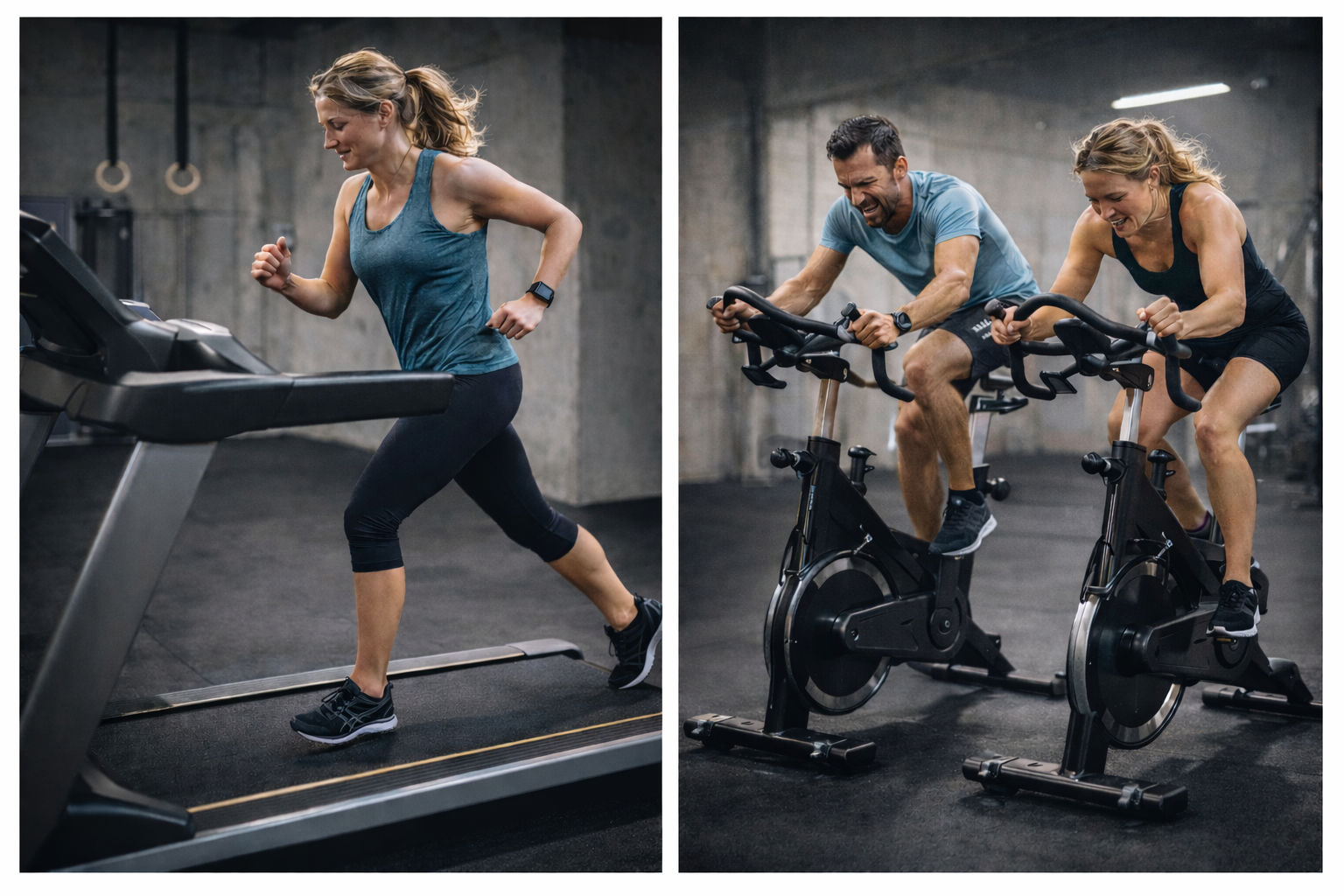
Foundation 2 — Muscle Mass & Resistance
Muscle Must Be Asked to Work Against Load
Muscle mass and strength are biological assets, not aesthetic traits.
Loss of muscle:
- Increases mortality risk
- Accelerates metabolic decline
- Predicts frailty, falls, and disability
- Reduces resilience during illness or injury
These risks increase with age—but muscle loss is modifiable at every adult stage of life.
What This Means Practically
Muscles must be regularly loaded through resistance.
Examples include:
- Bodyweight resistance
- Free weights or machines
- Resistance bands
- Functional strength patterns (squat, hinge, push, pull, carry)
The goal is not maximal strength.
The goal is preserving muscle and function across decades.
Muscle that is not challenged is biologically de-prioritized.
Resistance & Load — Dose Context (Reference)
Most adults meet meaningful benefit with 2–3 resistance-loading exposures per week, typically lasting ~20–60 minutes per session, depending on:
- Exercise selection
- Load used
- Individual recovery capacity
This guidance:
- Provides clarity
- Avoids rigid targets
- Keeps authority with the Fitness Priority Matrix
- Prevents “more is better” thinking
Upper-Range Encouragement (When Recovery Allows)
When recovery remains intact, sessions toward the upper end of this range may support greater strength and muscle preservation.
However, longer sessions are not required for longevity benefit.
When resistance exposure disappears for extended periods, muscle loss accelerates—even if other activity remains.

Foundation R — Recovery (Non-Negotiable)
Recovery Governs Whether Fitness Builds Capacity or Accelerates Decline
Recovery is not a fitness activity.
It is the biological condition that determines whether fitness signals are integrated or become stressors.
Without adequate recovery:
- Cardiovascular training increases injury and attrition risk
- Resistance training accelerates fatigue and muscle loss
- Foundational movement loses its restorative effect
Recovery is therefore non-negotiable.
Recovery Signals Include:
- Adequate, regular sleep
- Absence of persistent pain or unresolved soreness
- Energy sufficient to repeat activity across days
- Consistency without exhaustion or burnout
Governing Rule:
If recovery is compromised, load is reduced—regardless of category.
Recovery does not compete with fitness.
It determines whether fitness works.

Age-Inclusive by Design
These foundations apply across all adult life stages:
- Younger adults: Preserve capacity before decline begins
- Midlife adults: Slow biological aging and metabolic drift
- Older adults: Prevent frailty, falls, and loss of independence
Dose tolerance, recovery capacity, and progression vary by context.
The signals themselves do not change.
What Daily Fitness Foundations Are Not
They are not:
- A workout plan
- A requirement for daily execution
- A performance standard
- A substitute for recovery
They do not demand maximum effort.
They demand sufficient, sustained exposure to the right signals.
Relationship to the Fitness Priority Matrix
Daily Fitness Foundations sit downstream of the NIMARSTI™ Fitness Priority Matrix.
They exist to ensure that:
- Cardiovascular fitness does not disappear
- Muscle mass is not silently lost
- Foundational movement supports recovery
- Progress toward higher-benefit ranges occurs only when recoverable
When these signals are present consistently, most secondary benefits follow naturally.
Success Criteria
Success is not defined by:
- Numbers alone
- Streaks
- Discipline narratives
Success is defined by:
- Capacity retained
- Strength maintained
- Endurance preserved
- Independence protected
If cardiovascular capacity, muscle strength, foundational movement, and recovery are present in life, the foundations are being met.
Closing Principle
Longevity does not require extreme training.
It requires sufficient exposure, sustained over time.
Cardiovascular capacity.
Muscle mass.
Foundational movement.
Recovery.
Everything else is secondary.
Download the Daily Fitness Foundations (Printable PDF)
For those who prefer a visual, printable reference, the Daily Fitness Foundations are available as a high-resolution PDF.
This downloadable chart is ideal for:
- Daily or weekly reflection
- Home, gym, or workspace reference
- Sharing with family, clients, or care teams
The PDF mirrors the framework above and is designed as a supportive visibility tool—not a workout plan, checklist, or performance tracker.